
How We Work
Some firms have a process for websites. Another for brand. Another for print. Ours is the same across all of it—because the thinking that makes work good doesn’t change with the medium.
What changes is the form.
Every project starts here—before a single decision is made, before anything is designed, written, or built.
We need to understand what you’re trying to accomplish, who you’re trying to reach, and what already exists that we’re working with—or against.
This sounds obvious. It isn’t always practiced.
We ask a lot of questions in this phase—some you’ll expect, some you might not. We listen carefully to what you say and pay attention to what you don’t. We look at your existing materials, your market, your audience, and your competition. We come in genuinely curious about your organization, because the work that follows is only as good as our understanding of it.
On a brand project this means learning what makes your organization distinct before we consider a color or a typeface. On a website it means understanding your goals and your audience before we even inventory your content, let alone sketch a page. On a print piece it means knowing how the piece will be used, by whom, and where, before we think about size or format.
The output of this step isn’t a deliverable. It’s a foundation.
Be Curious.
Understand.
Before anything takes shape, we need to process what we’ve learned. This step is less visible than what follows—but it’s where the project actually begins to form.
We annotate, synthesize, and organize. We look for patterns in what we heard, tensions worth naming, and gaps worth filling. We start to develop a point of view about what the project needs to do and what it needs to avoid. If an audit is warranted—of existing content, existing brand materials, existing site structure—it happens here.
The output of this step varies by project. It might be a brief, a set of notes, a content audit, or simply a shared understanding between our team and yours. What it isn’t is decoration. Everything we produce in this step is in service of the work that follows.
On smaller projects, this step and the next may compress. That’s fine—the thinking still happens, it just happens faster.
Structure.
This is the step most people want to skip. It’s also the step that determines whether everything that follows holds together.
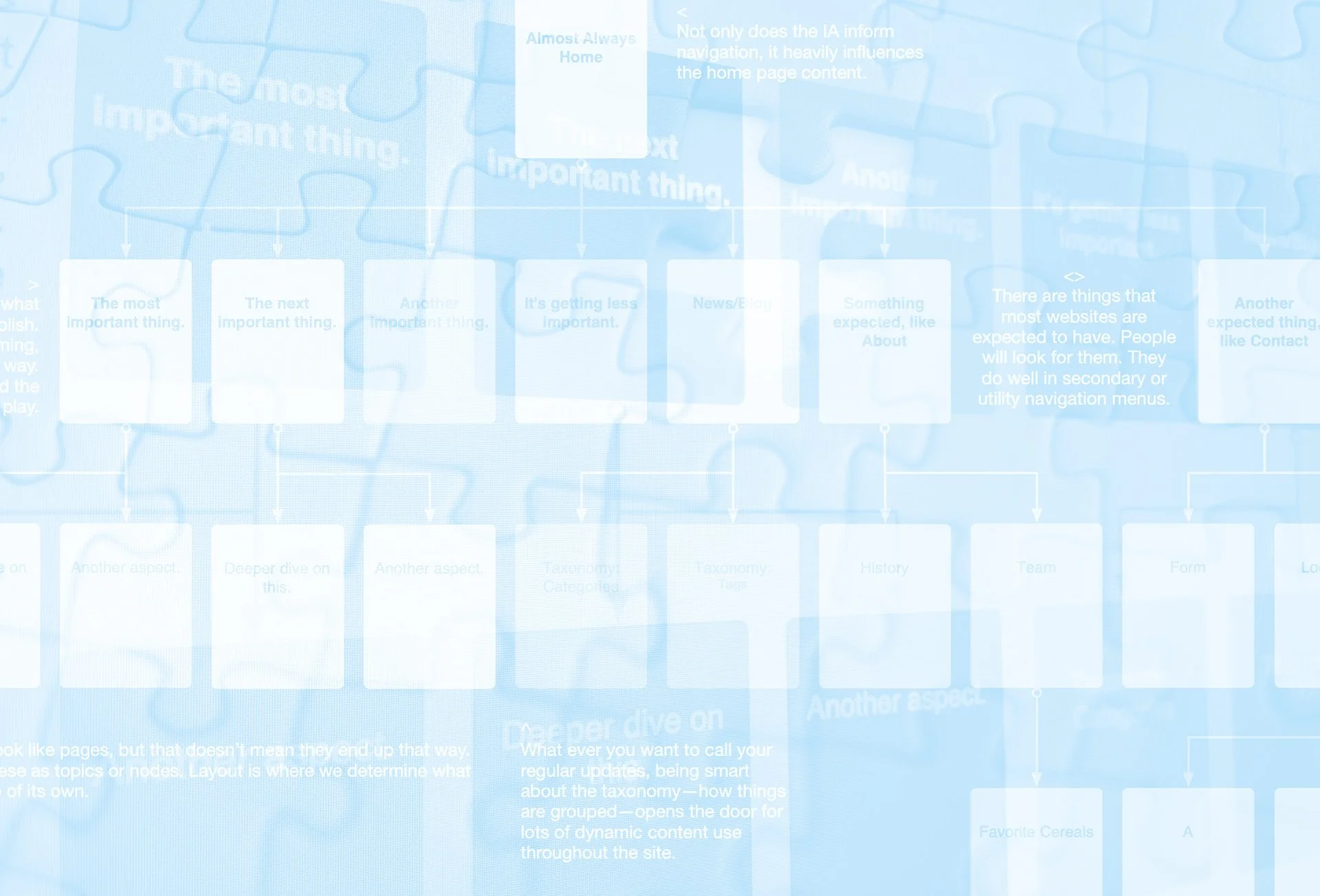
Before we design, write, or build, we need to know what the thing is made of and how the parts relate to each other. On a website, this is Information Architecture (IA)—the pursuit of arranging content so it can be found, understood, and used. We map the structure of the site before we touch the interface, because the interface should serve the structure, not the other way around. That IA document becomes a reference tool as we move through content strategy and design—and like any good reference, it’s a living document. We’ll test it against what we learn as the project develops and adapt it when we need to.
On a brand project, this step is about establishing the system before we execute it. What are the components? How do they relate? What are the rules that will keep everything consistent once it leaves our hands? On a print piece it’s about hierarchy—what does the reader need to encounter first, second, and third, and what happens if they don’t read it in order?
The form this step takes changes by discipline. The thinking doesn’t.
Make.
This is the part people picture when they think about design. It’s also the part that only works because of everything that came before it.
With a foundation in place, we start making. On brand projects we call this play—and we mean it. Sketches, experiments, type explorations, color studies. The goal is to try things before we commit to them, and to stay open to where the work wants to go. On a content project the equivalent is simple: Just write. Get any version of the words out. Drafts exist to be improved, and you can’t improve what isn’t on the page.
What we show at this stage—and how finished it looks—depends on the project and the audience. Early, rough work can generate great feedback in the right room. In others, brand projects with multiple stakeholders for example, we push further toward polish before we present. People respond to what they see, and a rough draft has a way of becoming the conversation instead of the work itself.
This is the step where curiosity and structure become something you can see.
Refine.
This is where good work becomes trustworthy.
Design gets fine-tuned. Copy gets edited. Links get tested. Every element gets examined not in isolation but in context—across devices, across print conditions, across the full range of ways someone might encounter it. We’re looking for anything that creates friction, confusion, or doubt. An unforced error at this stage—a typo, a broken link, a misaligned element—doesn’t just look careless. It undermines everything the work was trying to say.
This step has no shortcut. It requires patience and a specific kind of attention: Not the expansive curiosity of the first step, but a focused, methodical pass that assumes something is wrong until proven otherwise. That’s not cynicism. It’s craft.
On content it means editing for clarity, consistency, and voice—then proofing for errors that erode credibility. On brand work it means checking every application against the system we built. On a website it means testing across browsers, devices, and user scenarios before anything goes live.
The work isn’t done when it looks right. It’s done when it is right.
…Again.
For clients we work with over time, the process doesn’t end at launch—it restarts. A campaign wraps and we get curious again: What worked? What didn’t? What’s changed in your market, your audience, your organization? Things change. Good work adapts.

Let’s get started.
We start by getting genuinely curious about your organization, your goals, and your audience.
We make sense of what we learn before we start making decisions. We get the structure right before we start building. We make something—and we stay open to what it teaches us. Then we make it right, with the kind of attention that turns good intentions into trustworthy results.
We make things that work. And when things work, they tend to look right.